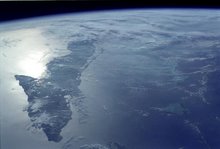
Website with trailer
here, reviews here from the New
York Times and Los
Angeles Times, and notes from El Pais here
and here. Now playing at Washington’s E Street theater.
Sunday, March 18, 2012
Friday, March 16, 2012
Church occupation ends
The Havana church protesters ended their 48-hour occupation when
police, called by the Archdiocese, showed up to remove them. The Archdiocese issued a statement
explaining the end of the saga, noting that government authorities gave the
assurance that no charges would be brought against any of the protesters. CNN story here.
Thursday, March 15, 2012
"He wanted to come as a pilgrim"
Here is the video of Cardinal Ortega's March 13 appearance on Cuban television explaining the upcoming papal visit.
Cuba's occupy movement
A number of Catholic churches in Cuba were occupied yesterday by Cuban
citizens who apparently demanded that Pope Benedict see them when he visits
Cuba later this month.
The Catholic church strongly rejected their tactic and demanded that
they leave church premises.
A statement from the Archdiocese of Havana said that a group of persons “who identify
themselves as dissidents” in one Havana church (the Basílica Menor de
Nuestra Señora de la Caridad) had a
message for the Pope and a “series of social demands;” they “refused to leave
the church,” the church was closed, and they remained inside, “frequently”
placing and receiving calls on their cell phones. Church authorities told the group that the
message would be delivered, but they declined to leave. The statement also noted that the church
communicated with Cuban government authorities, “who agreed to take no action
at all” against the protesters; that similar protests occurred in other
churches across Cuba but those involved departed the premises; and that as part
of a “prepared and coordinated strategy,” some dissidents and others were
encouraged to occupy churches but “declined to do so because they considered it
to be ‘an attitude of disrespect to the church.’”
The statement, signed by Archdiocese spokesman Orlando Marquez, said
these acts were “illegitimate and irresponsible,” and argued that “no one has
the right to convert places of worship into political trenches.”
Radio Marti’s story identifies the dissidents as members of the
Partido Republicano de Cuba.
On its website, the Partido Republicano de Cuba says its work includes supporting the internal dissidents, supporting
the U.S. embargo, and strengthening Radio and TV Marti. It also prints a statement from its members who were in the Havana church, naming the
protesters and listing some of their cell phone numbers, and it posts a
recording of the statement made from that church. It says churches were “occupied” by its
members in Las Tunas, Holguin, and Pinar del Rio. The statement calls for formation of a
provisional government “with the objective of creating a legal framework for
the functioning of the rule of law.”
It asks the public to enter a “national strike and to go into the
streets to demand their rights.” This Miami
website notes the events in Holguin, and the local bishop’s rejection of
the protest inside a church there.
The Partido Republicano de Cuba has a Miami office and appears to be led by Magdelivia Hidalgo.
Miami blogger Emilio Ichikawa reports that dissident Jorge Luis García Pérez Antúnez, in an
appearance on Radio Mambi, called the Partido
Republicano de Cuba “a creature that nobody knows.” He paraphrased Antunez saying that the
organization was made “by people outside of the island and has been absent”
from opposition activities in Cuba.
Ichikawa reports further that one of the Havana protesters was on Radio
Mambi this morning complaining that the church is not feeding them and is
thereby forcing them into an “involuntary hunger strike,” but nonetheless they
are “prepared to carry on toward the ultimate consequences.” We’ll see about that.
Radio Marti’s story includes audio from Martha Beatriz Roque, who expresses her “disagreement with using
the Catholic church in any way for political purposes.” Yoani Sanchez calls
the protests “invasive and disrespectful.”
AP
reports today that the group in the Havana church is no longer demanding to
see the Pope, but rather that he act as mediator and take up their demands with
the Cuban government.
I have no idea if this Cuban “occupy” movement and its day of protests
was hatched in Miami or by activists in Cuba.
But my bet is that opponents of the Cuban government will continue to
distance themselves from it. The protesters
have every right to request of the Vatican whatever they wish. But the Pope, Cuba’s church, and Cuba’s Catholic
laity are also entitled to celebrate a pastoral visit as they wish. The protests accentuate the image of a
movement focused more on actors outside Cuba than within, and they do the cause
of opposition to the Cuban government no favors.
Tuesday, March 13, 2012
Explaining the Pope's visit
AP: Cardinal Ortega will address the Cuban public on television tonight
in advance of the Pope’s visit.
The Herald’s Juan Tamayo covers the 20-minute
address.
Monday, March 12, 2012
Egypt and U.S. democracy programs
Writing at National
Review’s website, former Assistant Secretary of State Otto Reich takes a
side-by-side look at the Alan Gross case and that of the Americans who came
close to being put on trial in Cairo for their work there for the International
Republican Institute and the National Democratic Institute.
I’m not going to
compare the two cases – the Americans in Egypt, for starters, operated openly
out of their organizations’ local offices – but they are two cases of Americans
working on U.S. government-funded democracy programs who landed in legal hot
water in their respective jurisdictions.
Mr. Reich notes that the U.S. government used the leverage
of our massive economic and military aid program to press the Egyptian government
for their release. We have no such
leverage in Cuba, and he opposes trading Cuban prisoners in U.S. jails for
Gross, so he argues that Washington should threaten to “suspend remittances” if
Gross is not freed. Such a move, to the
degree Cuban Americans would comply, would hurt families who are responsible
neither for Mr. Gross’ actions or his arrest; I somehow doubt it would free him.
“Providing hard currency to any country holding American
hostages is both immoral and self-defeating,” he concludes. He leaves out the fact that we paid $330,000
bail in U.S. taxpayer money for each U.S. citizen freed when their legal
proceeding was suspended and their travel restrictions lifted.
I’m not suggesting a payoff is desirable or feasible in the
Cuban case. But the Egypt case is not as
pristine as Mr. Reich portrays it; its solution involved both high principle
and a cold cash payment from one government to the other.
Odds and ends
- While reading recent discussion of the Pope’s upcoming visit to Cuba, this message to the Pope from Guillermo “Coco” Farinas, a Santa Clara opposition figure, stood out. He writes “in the name of the Cuban nation.”
- What to make of this story by Alfonso Chardy of the Herald? A Cuban doctor who served in Venezuela and availed himself of an immigration program that the Bush Administration created especially for Cuban doctors was denied permanent residence here because he was a member of the mass organization for young communists (UJC). I’m not a big fan of the program for several reasons, one being that those Cubans who can find asylum in one country (granted, not all can) should be able to stay in that country, and there’s no need to create an entitlement to come to the United States. But after enticing this doctor to come to the United States, the denial of permanent resident status puts him in immigration limbo, and his UJC membership seems a very flimsy reason. His lip-service loyalty to the communist cause became clear when he deserted his post 15 days after arriving in Venezuela.
- Talk about a win-win-win situation – if pressures from Cuba’s friends had led to Cuba’s attendance at the April Summit of the Americas in Colombia, Havana et al. could have claimed victory, and Washington would have been left to figure whether to attend. It turns out Cuba will not attend and never asked to attend, its foreign minister informs us, and now the President of Colombia is thanking Cuba for “generously saying it did not want to create a problem for the Summit or for Colombia.” At the summit itself, it remains to be seen if Cuba’s friends will cause a little stink and force President Obama to deal with the issue of Cuba’s exclusion. The Cartagena summit is an OAS show, and Cuba is not a big fan of the OAS.
- The Treasury Department clarifies rules for advertising educational people-to-people travel.
Thursday, March 8, 2012
"Significant cooperation" on drug enforcement
Some nuggets from the Cuba
section of the State Department’s annual drug enforcement report, issued
yesterday:
Cuba
and the United States share a mutual interest in reducing drug flows in the
vicinity of the island, and in 2011, Cuba maintained a significant level of
cooperation with U.S. counternarcotics efforts.
Cuba
continues to dedicate significant resources to preventing illegal drugs and
illegal drug use from spreading on the island, so far successfully. The technical
skill of Cuba’s Border Guard, Armed Forces and police give Cuba a marked
advantage against [traffickers] attempting to gain access to the Caribbean’s
largest island. Greater communication and cooperation among the U.S., its
international partners and Cuba, particularly in the area of real-time tactical
information-sharing and improved tactics, techniques and procedures, would
likely lead to increased interdictions and disruptions of illegal trafficking.
The
Ministry of Armed Forces and Ministry of Interior’s combination of fixed and
mobile radars, coupled with visual and coastal vessel reporting procedures make
up an effective network for detecting illegal incursions of territorial air and
sea by narcotics traffickers.
In
2011, Cuba reported 45 real-time reports of “go-fast” narcotics trafficking
events to the U.S. Coast Guard (USCG). [Cuban border guards’] email and phone
notifications of maritime smuggling to the U.S. have increased in quantity and
quality, and have occasionally included photographs of the vessels suspected of
narcotrafficking while being pursued.
The
Cuban government presented the United States with a draft bilateral accord for
counternarcotics cooperation, which is still under review. Structured
appropriately, such an accord could advance the counternarcotics efforts
undertaken by both countries.
The
1905 extradition treaty between the United States and Cuba and an extradition
agreement from 1926 remain in effect.
Subscribe to:
Posts (Atom)